Types of Mice: How to Tell Them Apart (And Why It Matters)
In most US homes, you're dealing with one of three species: the house mouse, the deer mouse, or the white-footed mouse. Telling them apart matters — especially in Colorado and the Rocky Mountain region, where deer mice are the primary carrier of Hantavirus.
Key facts:
- Deer mice (Peromyscus maniculatus) are the primary reservoir for Sin Nombre virus, the strain of Hantavirus responsible for most US cases1
- House mice (Mus musculus) are not significant Hantavirus carriers1
- Deer mice are identified by their two-toned tail: dark on top, white on the bottom
- Hantavirus Pulmonary Syndrome has a case fatality rate of approximately 36–38%1
The 3 Most Common Types of Mice in US Homes
House Mouse (Mus musculus)

The most common indoor pest. House mice are small (2–4 inches body length), uniformly gray-brown with a lighter belly, a pointed snout, and a nearly hairless tail about the same length as their body. Their ears are large relative to their head.
House mice live almost exclusively around human structures. If you find droppings in your kitchen, shredded nesting material in a cabinet, or gnaw marks on food packaging, it's almost certainly a house mouse.
Hantavirus risk: Low. House mice are not a significant carrier of Sin Nombre virus.1
Deer Mouse (Peromyscus maniculatus)
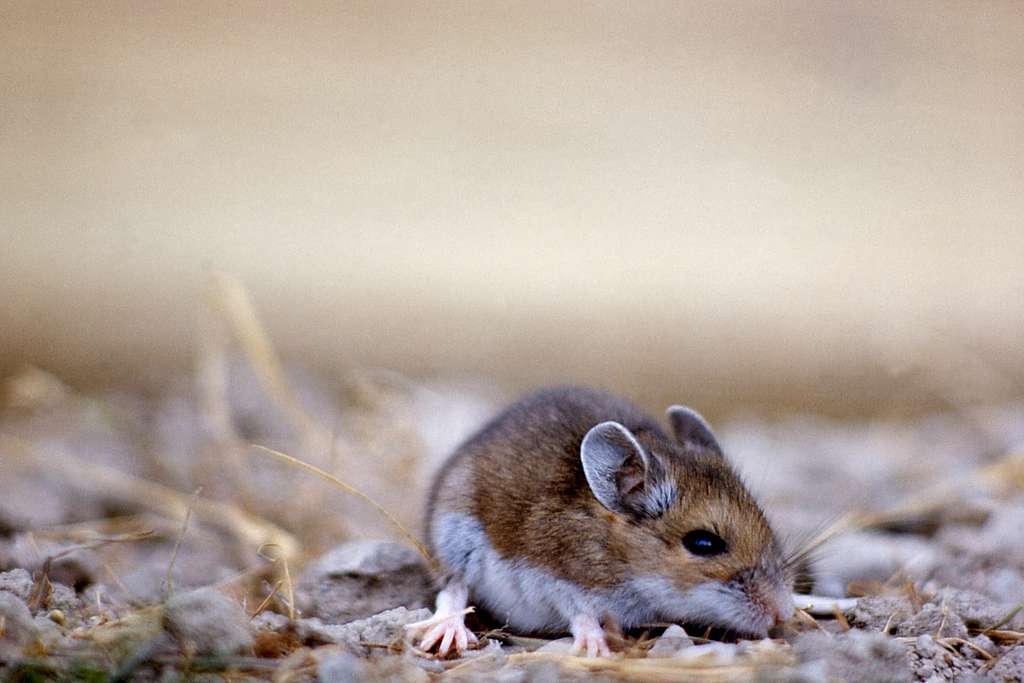
Slightly smaller than house mice, with a distinctive two-toned appearance: brown or grayish-brown on top, white underneath. The tail is also two-toned — dark on top, white on the bottom. Eyes are larger and more prominent than a house mouse's, and the ears are bigger.
Deer mice prefer outdoor habitats — fields, woodlands, and the edges between them — but will move into structures in fall and winter. In Colorado, they're common in foothill areas, rural properties, garages, and outbuildings. They're less likely to be found in urban kitchens than house mice, but they do enter homes.
Hantavirus risk: High. According to the CDC, deer mice are the primary reservoir for Sin Nombre virus, the strain of Hantavirus responsible for the majority of US Hantavirus Pulmonary Syndrome cases.1 Cases have been confirmed across Colorado and the broader Rocky Mountain region. What you need to know about health risks →
White-Footed Mouse (Peromyscus leucopus)
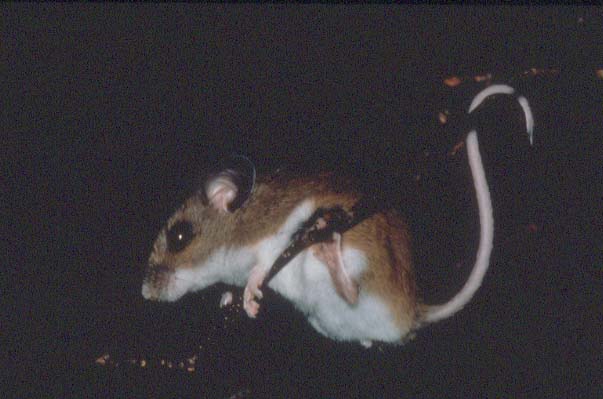
Nearly identical to deer mice — two-toned coat, white belly, white feet, large eyes and ears. Usually slightly smaller and more reddish-brown than deer mice. The tail is shorter relative to body length and the color contrast is less pronounced.
White-footed mice occupy similar habitats to deer mice: wooded areas, rural edges, and the outskirts of suburban neighborhoods. They're more common east of the Rockies.
Hantavirus risk: Moderate. White-footed mice can carry Hantavirus but are less commonly implicated than deer mice.1
Quick Comparison
| Feature | House Mouse | Deer Mouse | White-Footed Mouse |
|---|---|---|---|
| Color | Uniform gray-brown | Brown top, white belly | Reddish-brown top, white belly |
| Tail | Uniform color, hairless | Two-toned (dark/white) | Two-toned (less distinct) |
| Eyes/ears | Moderate | Large, prominent | Large, prominent |
| Typical habitat | Indoors, urban | Outdoor/rural, enters structures | Outdoor/rural, enters structures |
| Hantavirus risk | Low | High | Moderate |
Other Mice You Might Encounter
Meadow vole — Often called a "field mouse" colloquially, but voles are a separate genus. Stockier body, much shorter tail, smaller eyes. More of a yard and garden pest than an indoor one.
Jumping mice — Found in meadows and riparian areas in Colorado. Rarely enter structures. Distinctive long hind legs and very long tail.
Why the Distinction Matters
If you're in a foothill, rural, or semi-rural area of Colorado, the possibility that you're dealing with deer mice rather than house mice affects how seriously you treat cleanup. The standard guidance — don't dry-sweep droppings, wear gloves, ventilate before cleaning — applies to all mouse species, but it's especially important if deer mice are likely.
Safe cleanup protocol for mouse droppings →
The identification also affects where to focus your inspection. House mice nest deep inside structures and are year-round residents. Deer mice are more likely to be seasonal, entering in fall, and may nest in garage clutter, storage boxes, or outbuildings rather than inside finished living space.
Connect with a local pest control expert →
Sources
- Centers for Disease Control and Prevention. "Hantavirus." cdc.gov/hantavirus — Deer mouse (Peromyscus maniculatus) as primary reservoir for Sin Nombre virus; Hantavirus Pulmonary Syndrome case fatality rate; house mouse (Mus musculus) as low-risk carrier.